Thursday, October 29, 2015

Christophle Le More

This is the only known portrait of a black man in early European painting. He is thought to be the archer of King Charles V, Christopher Le More. He was part of the Brussels court. The sign of the Virgin on his red cap suggests he went to Halle for pilgrimage, favored by members of the Brussels court.

Jan Van Mostaert, 1525

The Spinners

Both of these 16th century Dutch works are betrothel paintings of the merchant class. The average person of the 16th century could not afford to be painted, would not be clothed in the latest finery and did not have leisure time to spin.

Both of the women in these portraits hold wool to spin to yarn or thread. This demonstrates that they are refined, virtuous (spinning wheel/drop spindle  symbolize virtue) and also productive, making them eligible wives.

The bottom painting (Pieter Pietersz 1660, Haarlem) shows the woman seated next to her betrothed, who is holding a tankard.  Her face questions the decision she needs to make - choosing between virtue (spinning wheel) and vice (tankard).

The irony is that women sentenced to prison were required to spin fiber during their incarceration.  Since fine cloth and lace were primary trading commodities of the Netherlands, one could surmise slave labor helped the economy. And how ironic that incarcerated women were REQUIRED to do what women of leisure CHOSE to do.

Wednesday, October 28, 2015

The Milkmaid

If you have never seen "Tim's Vermeer" get it on Netflix to learn how a digital film engineer spent 5 years reconstructing a room of Vermeer's time to exact specifications so that he could reconstruct a masterpiece using camera obscura to prove it was one of the illusions Vermeer employed. Master illusionists Penn & Teller produced this documentary.

The Milkmaid is most likely a lesson on diligence. She serenely pours the milk from the jug, capturing our attention with her quiet repose. But the lesson may warn against laziness as the background is in total disarray.  The walls are dirty and damaged, there is clutter on the floor, a window pane is broken, and day old bread lies torn in pieces on the table.

Often these Dutch housework scenes are designed to remind people to be diligent.

Vermeer was a master of fine detail. It is believed he used extremely fine dots to create the fine, translucent stream of milk.

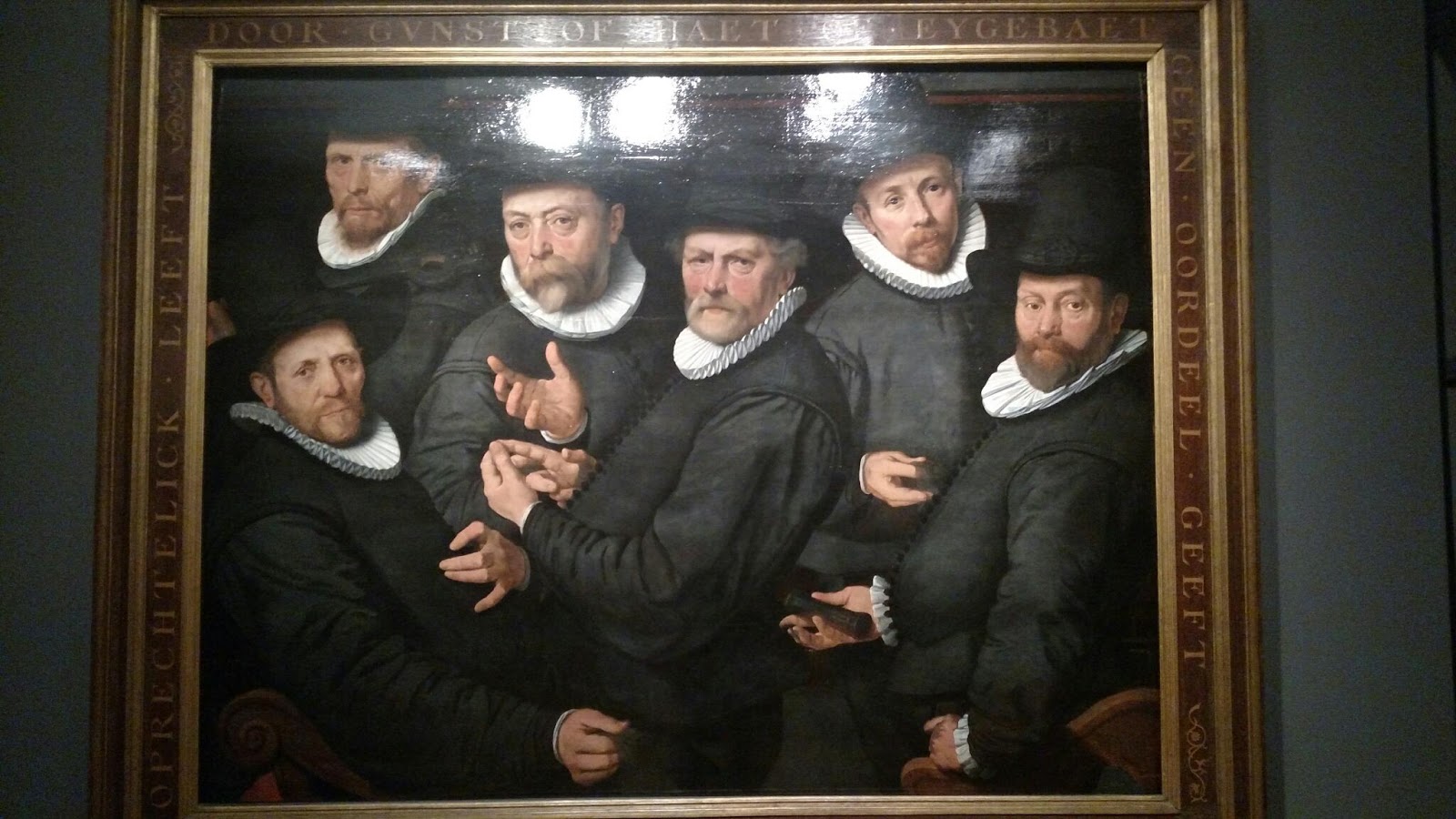
Six Wardens of the Drapers' Guild

This painting caught my attention for several reasons: first, my interest in fabric, but also because of the perspective. 

The wardens of the Drapers' Guild were responsible for inspecting and grading fabrics.  Several hold fine black fabric in their hands along with some tools of their trade.  Fine cloth exports were a very important trading commodity.

The perspective of this painting is unique. You can tell it was intended to be hung high because the perspective allows the viewer to see underneath the large brimmed hats and seemingly underneath the Turkish carpeted table.

This style is in keeping with traditional militia style paintings of the time, although not a military painting.  There is a bit more movement than what is seen typically in military works although the scale is equally grand as you can see from its scale compared to the public.

Painted by Pieter Pietersc in 1589.

Rijksmuseum Walls of Stained Glass

The grand hall and stairwells have floor to ceiling brilliantly colored stained glass window walls featuring important artists, musicians, architects, artisans, clergy, politicians and saints.

Wearing Different Hats

These "fulled" knitted hats belonged to Dutch whalers, who wore them down so low and their wool sweaters so high that only their eyes were visible.

Because dyed wool was more expensive, it signified a sailor's rank. The lowest ranking whalers all wore natural, undyed handknit wool stocking caps like the brown ones pictured.

Colored hats also served as a way for the whalers to find the boss quickly so they could follow orders conveyed with hand signals.

The hats were slightly fulled, meaning that after they were knit the hats were subjected to water warm enough to cause slight felting. This closes the stitch gaps for a warmer hat while still allowing the hat to be pliable vs. a completely felted, stiff hat.

I threw a photo of a velvet jeweled crown in as a juxtaposition of the different lots in life.

Dutch Florals

The Dutch pride themselves on growing the most exquisite flowers. Artists used the subject matter not only to portray beauty, but also to teach a lesson that everything is transitory, just as petals begin to wilt the moment the stems are cut. The florals also were used to emphasize the interdependence of all creatures, which is why insects are often included.

These works are from 1600.

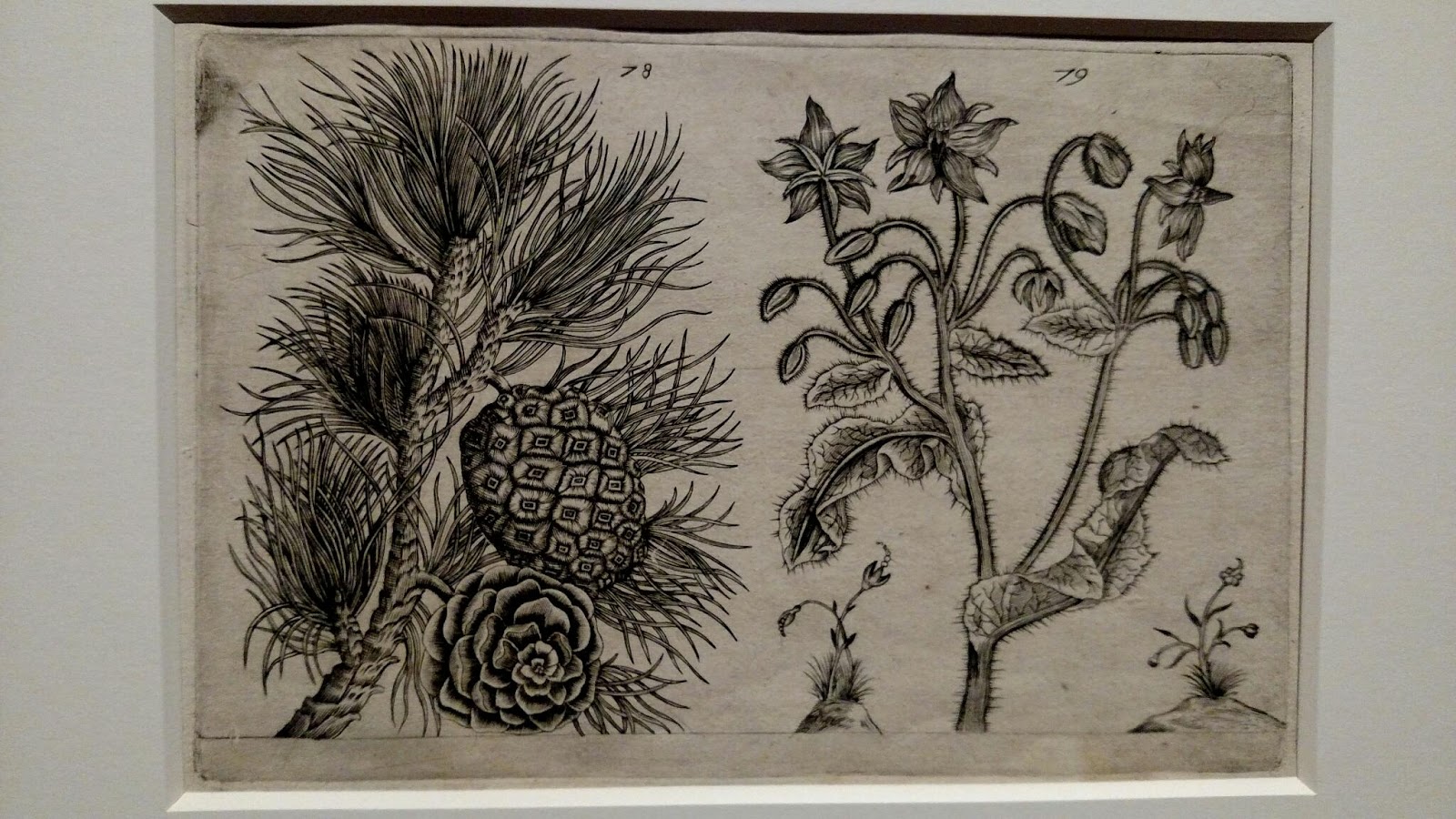
Cognoscite lilia agri

This series of a dozen botanical engravings from 1600-1604 are botanically technically correct. Typically a common plant is rendered opposite something more exotic or cultivated. 

The title comes from a statement attributed to Jesus which means, consider the lilies in the field, how they grow.

The detail is exquisite.

Medieval Sacred Art - Madonna & Child Genre

It is redundant to say "sacred art" because until the Renaissance and the advent of humanism, all art was sacred, or of a religious nature.

The art here at the Rijksmuseum begins in about the year 1100, before the development of perspective, shading/contouring, or other techniques used to create realism.  This was not a hindrance, as the subjects were not to be equated with mankind.

There were certain conventions painters needed to observe in creating sacred works; for example, the sky was only to be gold leaf, as it was heavenly.  A natural blue sky did not appear in art until the post plague artists, the Limborgini brothers created an illuminated book of the hours in about 1412-1416 for the Duke du Berry.

There were other conventions like the Madonna is always cloaked in blue and then there is an extensive range of symbols meant to teach the masses who couldn't read all about Christianity and the rules of society.

Madonna & Child Genre

Virgin & Child, 1300

This Madonna and child is immediately recognizable from the painting school of Siena, founded by Duccio in the 13th century. The giveaway?  It is at the very beginning of the Gothic era and still bears the tell tale Byzantine style that precedes the Gothic era.  The Byzantine style includes elongation (face, nose, eyes) long sinuous lines, almond shaped eyes, a deep blue cloak with a thin line of gold edging, flat two dimensional appearance and a Christ child that is really just a small adult.  This "Virgin and Child" is from the year 1300, painted by The Master of Badhia a Isola in Siena.


Orcagna's Madonna & Child, Florence 1350


Orcagna was the leading Florentine painter of the mid 14th century. This altarpiece which has survived almost in tact was commissioned in 1350 by a prominent citizen for a side altar in a church.  This work reflects the stiffer, more formal style of the period in a Gothic arched frame.

Madonna of Humility, 1400


"Madonna of Humility" (below) was painted 100 years later during the Italian Renaissance when humanism began.  Fra Filippo Lippi, a Florentine monk who left the order to marry a nun, was one of the most accomplished humanist painters.  He is famous for painting sweet emotional tenderness between mother and child.


The Madonna of Humility genre portrays Mary as a devotional mother either seated on the floor or on a cushion instead of on a throne on display. Fra Filippo Lippi takes liberties by embellishing the gold leaf background for decorative purposes, another humanist touch.  He also uses light-dark techniques for movement and perspective, adding realism to a theme formerly portrayed only as other worldly.


Tuesday, October 27, 2015

In the Garden

Today we spent 7 hours at the Rijksmusem and I enjoyed every minute.

I will be posting details of important paintings, but for now, here are some outdoor shots of this lovely structure that opened in 1800.  The tunnel you see between the two towers is actually a bicycle street that bisects the lower level of the museum.  When the museum was built, the city required it to tie the "old" to the "new" and with this tunnel, you can continue to access the old part of town.  And there are more bikes per capita here than anywhere in the world.


There are courtyards with life size chess, knot gardens, ponds, flowerbulb gardens, statues, mazes, fountains and places for musicians to perform all around the museum which makes it possible for everyone to enjoy.


Yesterday this was a lawn.  We watched men cut & roll the sod.  Today it is being turned into a bulb garden for Spring.  I watched them unload thousands of different bulbs.  They would take handfuls of bulbs from the different bags and toss them around.  I guess that is the technique to naturalize complementary colors.


Saw giant bumble bees still out enjoying the flowers.

Getting started on the day, bright and early.

The museum entrance is through the bike tunnel.


Here is a pond with a green house/conservatory in the background.  The brickwork on the building gives it interest, depth and it looks different with the changing light.


No, these kids are not getting wet in October!  This interactive fountain is open in the middle and every few minutes one side stops to allow people to run in.


Monday, October 26, 2015

Van Gogh v. Edvard Munch

We were too excited to go to sleep when we arrived in Amsterdam at 8:20 am local time, so we pulled an all nighter and just had a nice quick European breakfast, some strong coffee and walked to the Van Gogh Museum.


Our hotel is one block from the Rijksmuseum and the Van Gogh is located along the edge of a lovely green grass, tree lined park along with the Concert Hall, Museum of Modern Art and a collection of smaller museums.  Amsterdam Suid (South) is definitely the mecca of museum locations.


The Van Gogh Museum holds the world's largest collection of Van Goghs, but the two versions of world famous starry night are not in Amsterdam.  One is at the Museum of Modern Art in New York and the other traveled to this museum on loan as part of the Van Gogh: Munch Exhibition.

Compare & Contrast
The Van Gogh: Munch exhibit paired Vincent's artwork and letters to the Norwegian Expressionist artist's artwork and letters.  Munch is most famous for "The Scream" which was on display next to a Van Gogh painting of the very same bridge on which the famous painting of emotional terror and distress is depicted.

Image result for munch the scream

Edvard Munch (1863 - 1944) lived during the same time as Van Gogh (1853 - 1890), traveled in the same social and art circles, also in Paris, but they never met.  Munch knew of Van Gogh, and appreciated his "artistic fire" but they never met despite being mirrors of one another:

Mirrors of One Another
Both had a life long problem with anxiety, depression and despair and sought unsuccessfully to establish meaningful connection to people, both were spiritual and fixated on the stars, both were criticized publicly for their unconventional art, both injured themselves purposely (Van Gogh mortally shot himself and Munch shot his hand after a dispute with his girlfriend) and both had a deep desire to portray the suffering, sorrows and raw emotional expression of the working class.


Dark & Deep
Next to Vincent's paintings, Munch's paintings often portrayed the same models, the same places, the same theme, similar color values, similar emotions, etc. -- all created simultaneously and without interaction.  It was like looking at the world through two different filters colored by distress.  Jerry found it somewhat depressing, but I felt that both their seeking pushed them to try different styles and hone their skills to be expert at portraying the human condition and creating a genre that will endure forever.  There is something inexplicably alluring about Van Gogh that causes people all around the world to pay handsomely for his work.

Painting Philosophy
There was one variation between the two painters that was also at the heart of Van Gogh's public "break up" of his friendship with Gauguin:  Van Gogh painted what he saw.  He wanted to be inspired at the moment.  Munch often and Gauguin always painted from memory.  This caused a fiery dispute between Van Gogh and Gauguin that actually led to violence between them.  While it may sound frivolous, it is a proclamation of the essence of artistic inspiration.  If you believe it comes from your memory, it bears the imprint of your perspective.  If you believe it comes to you while you're observing, it comes from the moment or perhaps from beyond, as Van Gogh thought.  Van Gogh's upbringing in the home of a very strict, protestant father who was a pastor, most likely shaped this belief.  Obviously, they were each committed to their own perspectives.

Van Gogh moved deftly between pointillism, painterly impressionism, realism and line drawing.  He was equally eloquent in his letters to Theo. He talked about his connection to the beyond through the stars, which is probably what inspired him to paint under the stars.

 There had to be several dozen self portraits of himself in different styles.  I liked them all for different reasons.  I particularly liked this Van Gogh quote:  "People say it is difficult to know oneself; painting oneself isn't easy either."

Off to spend the day at the Rijksmuseum Tuesday.